

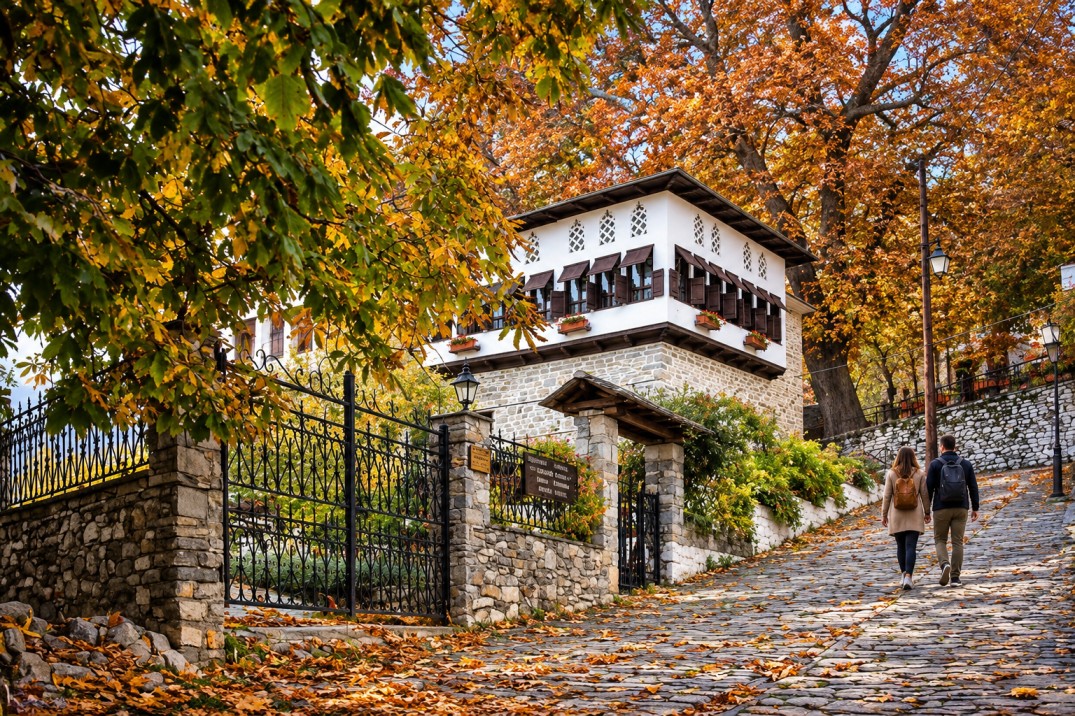

Greece is often associated with island beaches, ancient monuments and lively seaside towns, but some of the country’s most rewarding travel experiences can be found far from the usual tourist routes.
Across the mainland and the islands, traditional villages continue to preserve a slower, more authentic way of life. Stone houses, winding cobbled streets, shaded village squares and centuries-old customs create places where visitors can experience a very different side of Greece — one shaped by community, nature and tradition.
If you are looking to explore beyond the familiar, these villages are worth adding to your Greek travel itinerary.
Nymfaio, Florina
Set high on Mount Vitsi in northern Greece, Nymfaio is a beautifully preserved mountain settlement known for its stone mansions, narrow paths and forested surroundings.
The village has an elegant, almost fairytale-like atmosphere, particularly in autumn and winter when the surrounding mountains take on rich seasonal colours. Its traditional architecture and peaceful atmosphere make it ideal for travellers looking for a slower escape surrounded by nature.
Kapesovo, Zagori
Deep in Epirus, Kapesovo is one of the traditional villages of Zagori, a region famous for its stone architecture, cobbled paths and historic bridges.
The village is particularly appealing to travellers who enjoy walking and exploring on foot. Old stone houses and impressive mansions line its quiet streets, while nearby trails connect it with the dramatic mountain landscape of the Pindus range.
Zagori’s traditional settlements are part of a wider cultural landscape recognised by UNESCO, reflecting the close relationship between the villages, their architecture and the surrounding environment.
Vathia, Mani
In the southern Peloponnese, Vathia offers a completely different interpretation of the traditional Greek village.
Its imposing stone tower houses rise dramatically from the rugged Mani landscape, reflecting the region’s distinctive architecture and turbulent history. Today, Vathia is largely quiet, allowing visitors to appreciate its striking setting and unique character without the bustle found in more developed destinations.
It is a particularly memorable stop for travellers exploring the Mani peninsula by car.
Vyzitsa, Pelion
Surrounded by chestnut and beech forests, Vyzitsa is one of Pelion’s most atmospheric traditional villages.
Its beautifully preserved mansions, stone pathways and lush surroundings showcase the distinctive architectural character of the region. Like many Pelion villages, it also offers an appealing combination of mountain scenery and easy access to the coast.
A visit here can easily become part of a wider Pelion road trip, combining traditional villages, forest walks and beaches.
Mesta, Chios
On the island of Chios, Mesta feels worlds away from the island’s better-known coastal destinations.
The village was built as a fortified settlement, with thick stone walls and narrow, labyrinthine streets that were designed to offer protection from pirate raids. Walking through its arched passageways today is like discovering a living piece of medieval Greece.
Mesta is also part of Chios’ historic mastiha-producing villages, connecting its architecture with one of the island’s most distinctive traditions.
Why Visit Greece’s Traditional Villages?
These villages offer something increasingly valuable to today’s traveller: the opportunity to slow down.
Instead of simply moving from one attraction to another, visitors can spend an afternoon drinking coffee beneath a plane tree, walking along an old stone path, discovering a family-run taverna or simply watching village life unfold.
They also reveal the extraordinary diversity of Greece beyond its most famous destinations. From the mountains of Epirus and Florina to the forests of Pelion, the rugged landscapes of Mani and the medieval villages of Chios, traditional Greece takes many different forms.
For travellers willing to venture a little further, these communities offer a chance to discover a quieter side of the country — one where architecture, landscape and local traditions continue to tell the story of Greece.

