


From delicate purple flowers to one of the world’s most precious spices, Kozani saffron is a remarkable part of Greece’s agricultural heritage. Discover the traditional harvesting methods, the history of its production and the cooperative preserving this unique local tradition.
In northern Greece, in the region of Western Macedonia, a small purple flower gives rise to one of the country’s most treasured agricultural products. Known as Krokos Kozanis, Greek saffron is often referred to as the “Red Gold of Greece”, valued for its distinctive aroma, rich colour and labour-intensive production process.
Cultivated in the wider Kozani area since the 17th century, saffron has become closely connected with the region’s identity, bringing together generations of local producers and preserving a tradition that continues to play an important role in the local economy.
The History of Kozani Saffron
Although saffron cultivation dates back to ancient times in the wider Greek world, its systematic production in Kozani began in the 17th century, when traders introduced the crocus plant to the region.
Over the centuries, cultivation gradually expanded across a group of villages known as Krokohoria, or the Crocus Villages. The area’s soil and climatic conditions proved particularly suitable for growing Crocus sativus, the flower from which saffron is obtained.
Today, Krokos Kozanis holds Protected Designation of Origin (PDO) status from the European Union. This means that its cultivation, harvesting, processing and preparation must take place within the designated geographical area, following specific traditional methods.
From Flower to Spice: The Traditional Harvesting Process
One of the most fascinating aspects of Kozani saffron is the amount of care and manual work required to produce it.
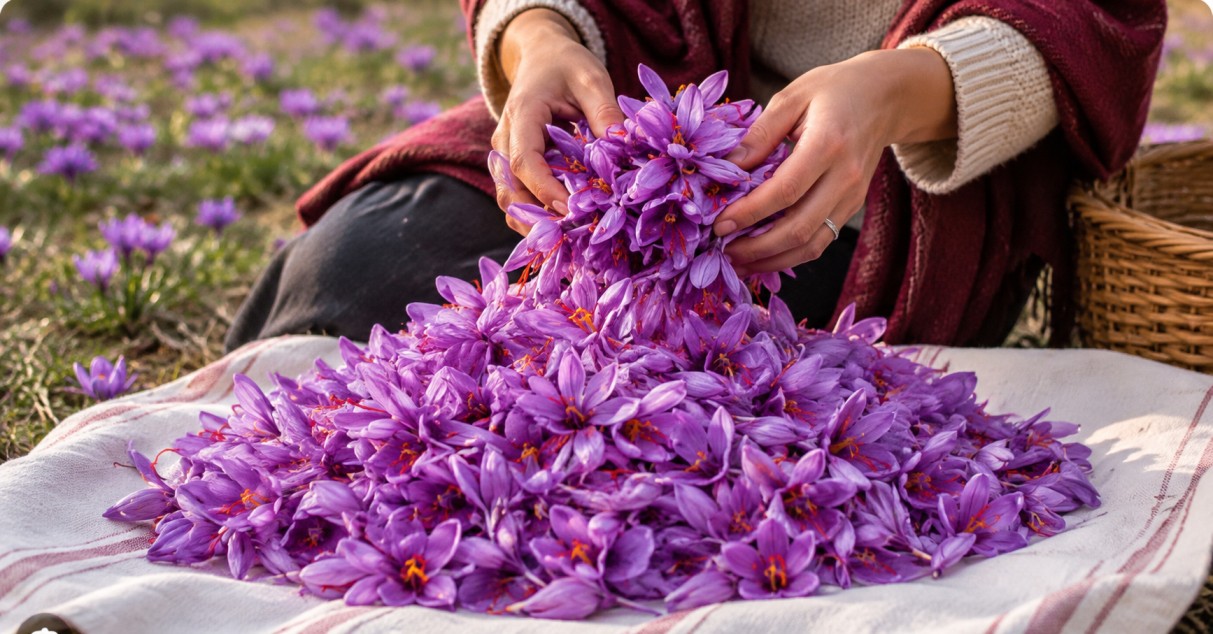
Every autumn, usually from mid-October to early November, the fields fill with delicate purple crocus flowers. Their harvesting is carried out entirely by hand, as the flowers are too fragile for mechanical collection.
Producers and seasonal workers carefully pick the flowers, often beginning early in the morning, before transferring them for processing. The three deep red stigmas at the centre of each flower are then separated by hand and carefully dried to preserve their colour, aroma and quality.
The process is particularly demanding because a very large number of flowers is required to produce even a small quantity of dried saffron. This explains why the spice remains one of the most valuable in the world.
The Kozani Saffron Producers Cooperative
An important role in preserving this agricultural heritage belongs to the Kozani Saffron Producers Cooperative, established in 1971.
Based in the village of Krokos, the cooperative brings together approximately 1,000 members and oversees the collection, processing, standardisation, packaging and distribution of the region’s saffron.
Its work helps maintain consistent quality standards, protect the authenticity of Krokos Kozanis and support local producers. The cooperative also contributes to the development of the product in international markets, helping bring Greek saffron to consumers around the world.
Visiting the Home of Greek Saffron
For visitors exploring Western Macedonia, a visit to the Kozani Saffron Producers Cooperative offers an opportunity to discover the story behind this distinctive Greek product.
The cooperative organises guided visits where visitors can learn about the cultivation of crocus, the traditional harvesting process and the different stages of saffron production. The experience also includes a photographic exhibition and an introduction to the spice’s uses in gastronomy and other industries.
Those visiting during the autumn harvesting season may also have the opportunity to see the crocus fields and experience the agricultural tradition first-hand.
A Taste of Kozani’s Heritage
From traditional Greek recipes and beverages to contemporary gastronomy, Krokos Kozanis continues to inspire chefs, producers and food enthusiasts.
More than just a valuable spice, it represents centuries of agricultural knowledge, local craftsmanship and the connection between a region and its land.
For travellers interested in discovering Greece beyond its famous islands and coastal destinations, Kozani offers a different kind of experience, one where local traditions, authentic flavours and agricultural heritage come together.
