

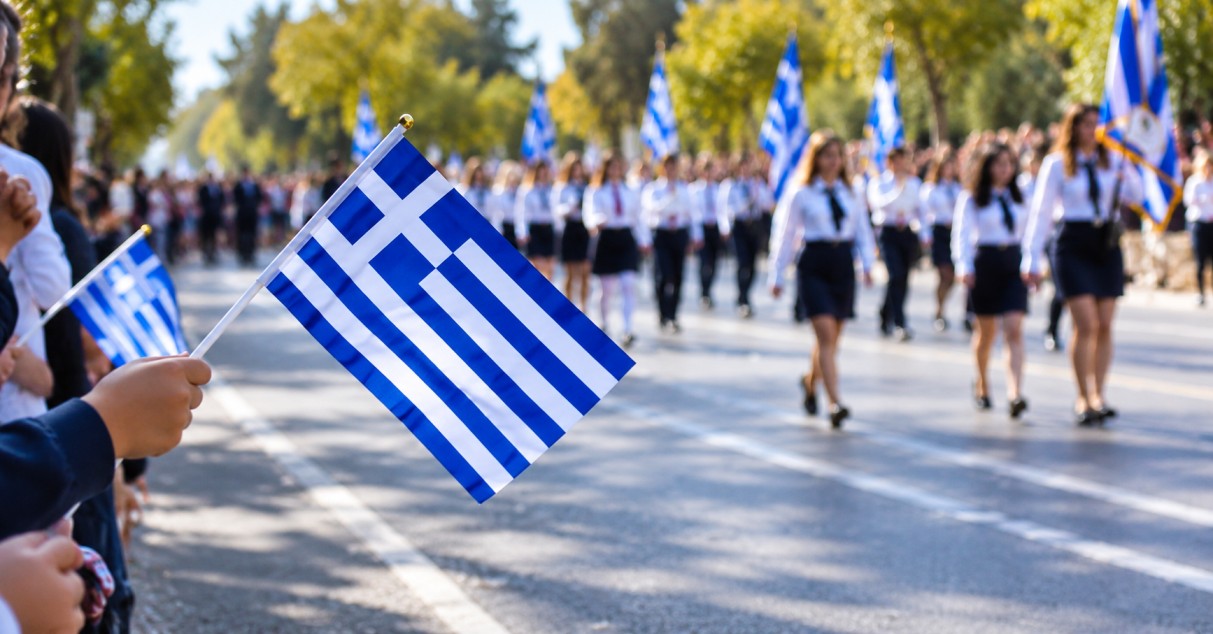

Every year on 28 October, Greece marks Ohi Day, one of the most significant dates in the country’s modern history. Across the country, Greek flags appear on balconies, schoolchildren take part in parades, and communities come together to remember the events of 1940.
But beyond the familiar story of Greece’s refusal to surrender to fascist Italy, there are lesser-known details that reveal a more complex picture of the people, politics and events behind this national anniversary.
Here are five fascinating facts that offer a closer look at the history of Ohi Day.
1. The Famous “No” Was Not Quite the Word That Was Spoken
The story of Ohi Day is often told through one powerful word: “Ohi”, meaning “No” in Greek. However, the actual exchange between Greek Prime Minister Ioannis Metaxas and the Italian ambassador, Emanuele Grazzi, was more nuanced.
In the early hours of 28 October 1940, Grazzi arrived at Metaxas’ residence in Kifissia to deliver an ultimatum from Italian dictator Benito Mussolini. Italy demanded permission to move its troops into Greece and occupy strategic locations.
According to Grazzi’s account, Metaxas responded in French, the diplomatic language of the time, with the words “Alors, c’est la guerre” — meaning “Well then, it is war”.
The refusal became known as Ohi Day through the way the events were reported and remembered. The word captured the essence of Greece’s response, transforming a diplomatic confrontation into a lasting national symbol.
2. Greece Was Already Living Under an Authoritarian Regime
One of the most striking aspects of Ohi Day is the political background of the man at its centre.
Ioannis Metaxas had established an authoritarian dictatorship in Greece in 1936, known as the 4th of August Regime. His government restricted political freedoms, censored the press and suppressed opposition.
Despite ideological similarities between his regime and other authoritarian governments in Europe, Metaxas ultimately rejected Italy’s demands in October 1940.
Greece’s refusal was shaped by its strategic interests, international relationships and the threat posed by an Italian invasion. The episode illustrates an important historical distinction: the decision to resist a foreign power did not mean that the government itself was democratic.
This complicated political context makes Ohi Day a particularly interesting moment in modern Greek history, extending beyond a simple story of national pride.
3. The Italian Invasion Did Not End With the Ultimatum
The refusal to accept Italy’s demands was followed almost immediately by military action. Italian forces invaded Greece from Albania in the early hours of 28 October 1940, opening the Greco-Italian War.
What followed surprised many observers. Greek forces resisted the invasion and, during the subsequent counteroffensive, pushed Italian troops back into Albanian territory.
The campaign became an important moment for the Allied cause during the early years of the Second World War, when much of Europe had already fallen under Axis control or occupation.
Greece’s resistance did not prevent the country from being invaded by Nazi Germany in April 1941. Nevertheless, the campaign against Italy became a defining episode in the nation’s wartime history and a source of encouragement for countries fighting the Axis powers.
Ohi Day therefore commemorates not only the rejection of an ultimatum but also the resistance that followed.
4. Some of Greece’s Best-Known Artists Experienced the War First-Hand
The Greco-Italian War affected people from every part of Greek society, including writers, poets and artists whose work would later become an important part of the country’s cultural heritage.
Among them was Odysseas Elytis, the celebrated Greek poet who served during the campaign. His experiences during the war informed his literary perspective, and his work Axion Esti would become one of the most influential works of modern Greek literature.
Other notable Greek cultural figures also served during the conflict, including painters Yannis Tsarouchis and Spyros Vasileiou, as well as writers Nikiforos Vrettakos and Angelos Terzakis.
Their experiences offer another way to understand the war: not only through military events and political decisions, but also through the lives and creative work of those who lived through it.
The connection between war, memory and artistic expression remains an important part of how Greece remembers this period.
5. Ohi Day Is Celebrated on the Date of the Refusal, Not the End of the War
Many national commemorations mark the end of a conflict or the signing of a peace agreement. Ohi Day is different: it takes place on the anniversary of the decision that brought Greece into the war against Italy.
The date has come to represent the moment Greece refused to accept the demands of a foreign aggressor, regardless of the consequences.
Today, 28 October is a national public holiday. School and military parades take place throughout Greece, while flags decorate public buildings, homes and streets. The celebrations also extend beyond the country, with Greek communities around the world commemorating the occasion.
For those living in Greece, it is also a chance to experience a tradition that brings history into everyday public life. The parades, ceremonies and displays of national colours are reminders of how a moment from 1940 continues to shape Greek identity.
Why Ohi Day Still Matters
More than eight decades after the events of October 1940, Ohi Day remains an important date in Greece’s collective memory. Its significance lies not only in the famous refusal itself, but also in the historical circumstances surrounding it, the resistance that followed and the lives affected by the war.
For international residents and visitors, understanding Ohi Day offers a deeper insight into modern Greek history and the traditions that continue to bring communities together every October.
It is a reminder that sometimes a single decision can become much larger than the person who makes it — turning into a symbol of a nation’s determination to defend its independence.

