

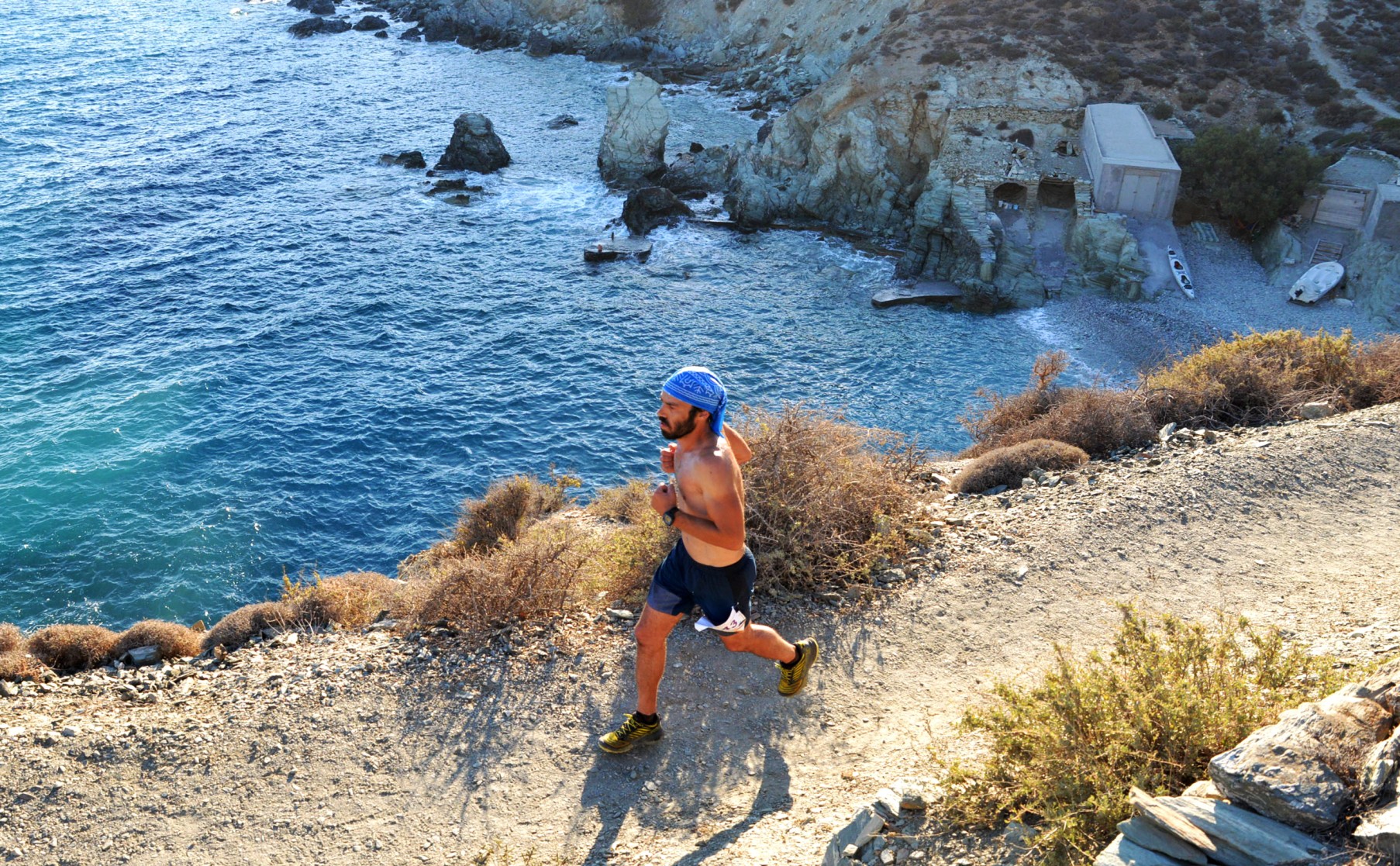

There was once a different way to discover the Cyclades.
Not only from the deck of a ferry. Not only from a beach, a table in a village alleyway or a sunset.
But by running along an old stone-paved path. Climbing a forgotten road. Passing through a village. Entering a monastery. Listening to music in a courtyard. Tasting local food at an aid station.
For a while, there was a way to discover a Greek island by running through it.
That was the Cyclades Trail Cup — a series of trail running races created in 2015 that travelled from island to island until 2019. Along the way, it visited 11 islands and created or hosted 23 trail running events.
But the Cyclades Trail Cup was never simply about times and kilometres. It was born from a desire to experience the Cyclades differently.
It All Started with a Trail
The story had actually begun a little earlier.
In September 2014, in northern Tinos, in the area where my father comes from, around Pyrgos and Panormos, the first Exomeria Trail Race was organised.
Before the race could even take place, around 20 kilometres of trails had to be cleared. Together with the local cultural association and the Municipality of Tinos, we reopened paths that could be used by runners but would also remain available to walkers.
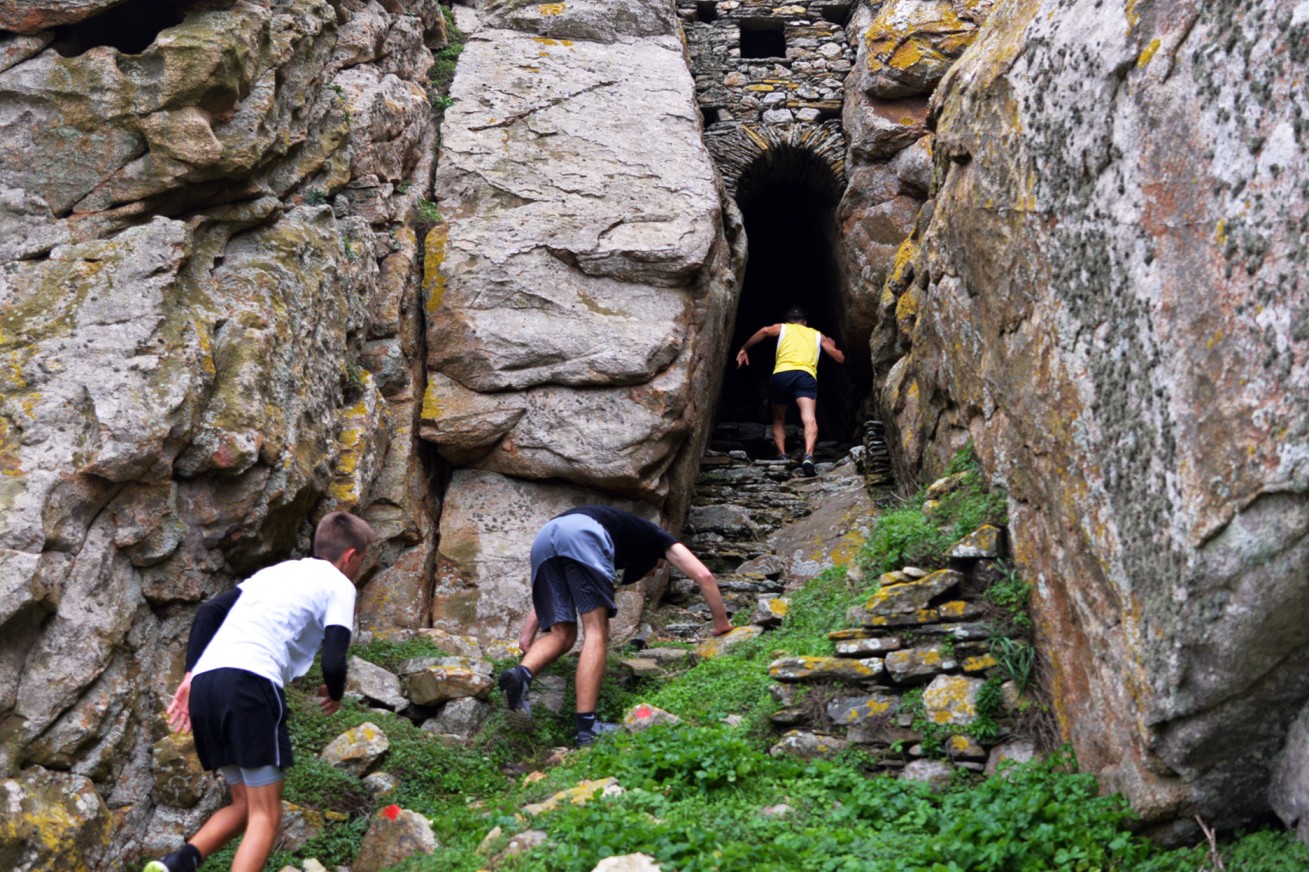
Around 90 people stood at the starting line. The race was a success. But the most important thing was not the number of participants. It was the idea that remained.
A race could be an opportunity to bring an old trail back to life. To bring people to a place. To introduce visitors to parts of an island they might never encounter through conventional tourism.
And somewhere along the way, another thought emerged: nothing had to be done the way it had always been done.
Why did a medal have to be made of metal? Why did a prize have to be a trophy?
In Tinos, 11 marble sculptors were invited to create a different work of art, inspired by four key words. The works were not simply presented at the awards ceremony. They were exhibited for three months at a museum in Pyrgos, waiting for the race that would eventually give them to the winners.
The race and culture had already begun to intertwine.
When the City Became the Trail
A little later, the journey took me to Syros.
I did not find the mountain I had expected. Instead, I found Ermoupoli.
And so another idea was born: a race through the city.
Ten kilometres through the narrow streets of Ermoupoli, with thousands of steps, starting from Miaoulis Square and passing through the historic Town Hall, the Apollo Theatre, Agios Nikolaos, the Kyveli Institute, Ano Syros and the home of legendary rebetiko musician Markos Vamvakaris.
The runners were not simply passing by the city’s landmarks. They were running through them.
Along the route, they could encounter poetry in a courtyard, hear a bouzouki being played at the home of Markos Vamvakaris and experience the city in a way that felt nothing like an ordinary road race.
The route passed through a dense network of narrow streets, stairways and intersections, requiring a completely different approach to marking the course.
The solution was simple and ingenious: blue adhesive tape was placed on the ground, creating a broken line that guided runners along the entire route.
Piece by piece, step by step, the narrow streets of Ermoupoli became a unique race course.
And so, the Syros City Trail proved that a trail race could exist even in the heart of a historic city.
And Then Came Andros
From Korthi towards Lardia and Giannisaio, and from Panachrantos Monastery towards Livadia, Syneti and the Castle of Kochylou, a 24-kilometre route with around 1,600 metres of elevation gain was designed through an enormous network of trails.
Alongside it were shorter 10- and 5-kilometre routes.
The courses passed through villages. Residents came out into the streets, applauding and helping the runners. At Panachrantos Monastery, the monks offered the athletes water and food.
More than 200 volunteers supported the race.
By then, every race had become another lesson.
Tinos had shown me that a trail could be brought back to life.
Syros had shown me that a city could become a trail.
Andros had shown me that an entire network of trails could be transformed into a racing experience.
And somewhere along the way, a simple question emerged:
Why two and not three?
The Idea of the Cyclades Trail Cup
That was when I realised that the races could become something more.
Why not create a championship that travelled from island to island?
And so, the Cyclades Trail Cup began to take shape.
The idea was simple, although it was far from obvious at the time: to connect different races, on different islands, under one common philosophy.
Each race could have its own personality. The route could be different. The landscape, the food, the history, the people and even the way the event was organised could change.
What could not change was the quality and the overall experience.
Gradually, specific criteria and requirements were established for the races taking part in the series: consistency across the calendar, routes with a significant proportion of stone-paved paths, cultural activities, promotion of local products, communications, emergency planning, environmental practices, common signage and promotion of the Cyclades Trail Cup.
2016 was the first official year of the championship, with three races in Tinos, Syros and Andros.
In 2017, Naxos, Amorgos and Donousa joined the series.
In Naxos, another idea was born that would later travel to the other islands: information sessions on sports and alternative tourism.
The aim was to introduce local professionals to trail running, the athlete as a visitor, and the ways in which a sporting event could connect with the local economy and help extend the tourist season.
When a Race Becomes a Journey
In Amorgos, one race began with a boat trip.
The Spike, an idea of my own, was born from the desire to turn the unique geography of Amorgos into part of the racing experience.
The athletes travelled by traditional boats to Nikouria island and, starting from the beach, climbed to its highest point before making their way back.
One small journey within the journey itself.
In Kea, the Kea Challenge became a two-day experience: a downhill route towards ancient Karthaia, races the following day, an archaeological tour, a cultural treasure hunt in Ioulida, a folklore museum, music and local treats.
The game Ioul…eida invited children and adults to solve clues through the narrow streets of Ioulida, discovering stories, traditions, architectural details and people connected to the island.
In Ios, preparing for the races involved clearing trails and reopening old routes.
In Folegandros, a 10-kilometre route followed the island’s western and southern coastline, from Taxiarchis to Chora.
In Tinos, the aid stations offered more than water. There were local flavours, Nissos beer, nuts, stuffed figs, savoury bites and fanouropitakia from local businesses.
Athletes could start their day with a local breakfast, take part in a Pasta Party at a monastery and meet the people of the villages along the route.
The race was the reason to come. The island was the real destination.
When the Idea Became a System
By 2018, the Cyclades Trail Cup had grown enough to need its own set of rules.
The CTC Point System was created so that every race, regardless of its distance, could award points.
Each race was assigned a difficulty level based on factors such as distance, elevation gain, stone-paved paths, asphalt and aid stations, with additional factors for weather conditions and race ranking.
At the same time, common environmental practices and a volunteer network were established, so that a race would not depend entirely on the human resources available on each individual island.
And so, what had started with a few personal routes had evolved into an entire model.
Eleven Islands Later
From 2016 to 2019, the Cyclades Trail Cup travelled through Tinos, Syros, Andros, Naxos, Amorgos, Donousa, Kimolos, Ios, Kea, Folegandros and Kythnos.
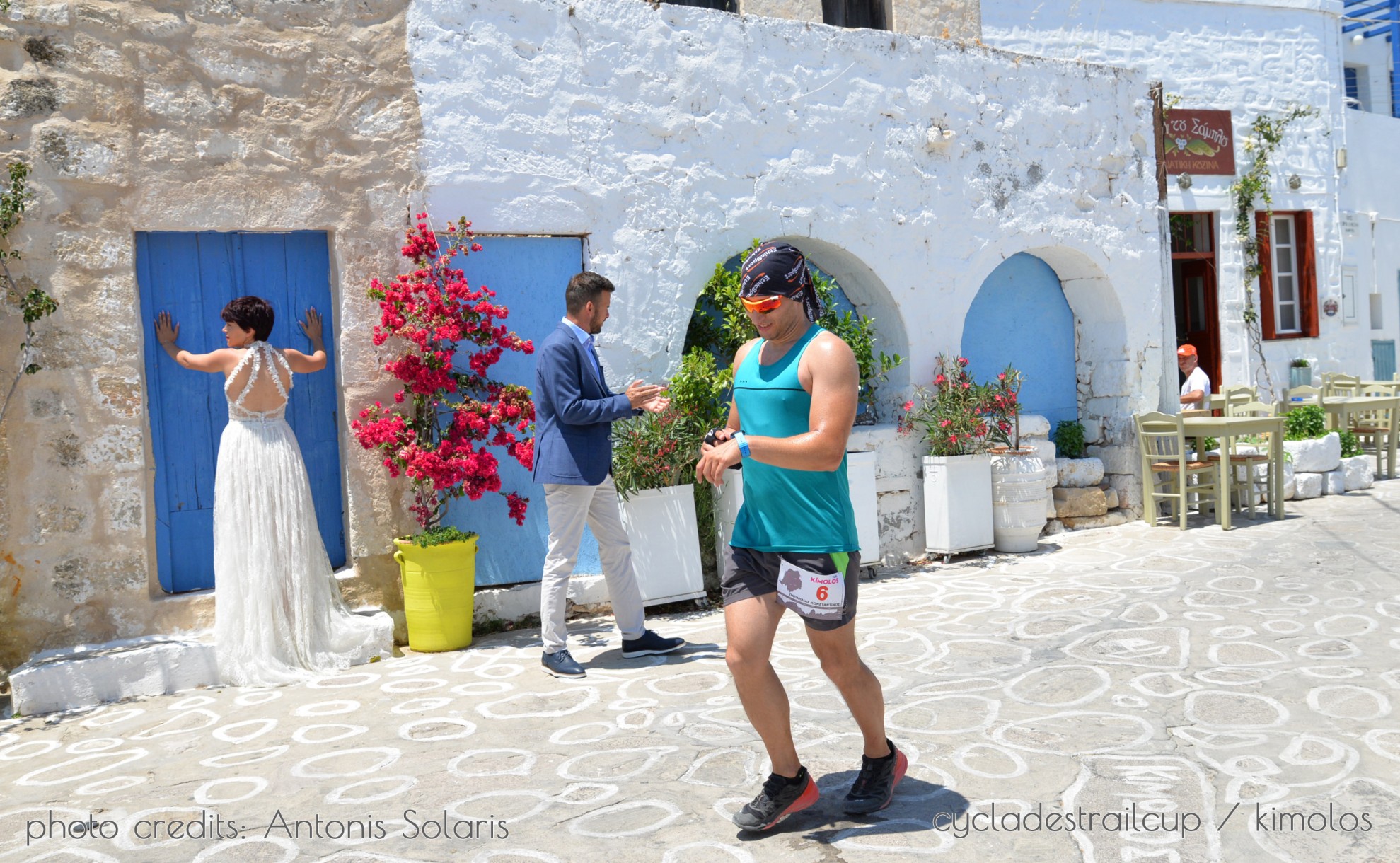
Twenty-three races. Hundreds of athletes. Participants from Greece and abroad.
Trails that were cleared. Villages that opened their doors. People who became volunteers. Businesses that contributed their own small piece to the story of each event.
And behind all of it were people.
Volunteers. Athletes. Village residents. Monks. Cooks. Hoteliers. Small businesses. Municipalities and local associations. Sponsors.
And one person who, each time, had to find the route again, solve the next problem and take the next step.
The Final Journey
In 2019, the Cyclades Trail Cup began its final season.
Kea opened the year. Folegandros returned for a second time. Andros continued on its own path, while Kythnos finally managed to hold its race.
Once again, people from different places came together on the islands to run, walk, discover new places and share a few days of their lives.
And the races went well.
But somewhere between the routes, the ferries, the preparations and the countless small details required to make each event happen, something had begun to change.
For me.
Perhaps it was the exhaustion of so many years. Perhaps it was all the unexpected problems that had to be dealt with every time. The responsibility for the people taking part. The endless hours of work. And the financial effort required to keep the project going.
The races were still moving forward.
But slowly, I was reaching the end of my own road.
Tinos was scheduled for December. Eventually, the event was postponed and then cancelled, as the necessary conditions for its safe organisation had not been secured.
And so, without one defining moment, without an official closing ceremony, I decided to stop.
Not because the races had lost their value.
But because, at some point, I needed to leave some space for my own life.
Then came the pandemic.
The ferries stopped. The islands emptied. The roads and trails fell silent.
And the Cyclades Trail Cup remained where it had always belonged: on the islands, on the trails and in the memories of those who had experienced it.
The Trails Remained
Perhaps that is ultimately the most important thing.
The Cyclades Trail Cup ended.
The trails remained.
The stone-paved paths of Tinos. The steps of Ermoupoli. The trails of Andros. Ancient Karthaia in Kea. The coastline of Folegandros.
The villages that once waited for runners.
The courtyards where music was played.
The tables where pasta was prepared for dozens of people.
The museums that opened their doors.
The volunteers who travelled from island to island.
And somewhere within all of this, an idea remained:
That the Cyclades can be experienced differently.
Not only by looking.
But by walking, by living, and, even for a little while, by running.
For a few years, the Cyclades were not simply a destination.
They were one great route.
And we ran it.
Once, we ran the Cyclades
Robert Konstantinos Karalis
Founder & Technical Director, Cyclades Trail Cup

